
DEFEND OUR MARINES

SSgt Frank Wuterich slander suit against Congressman Murtha
Index of legal documents
Complaint Against John Murtha by Frank D. Wuterich: Action for Libel; Invasion of Privacy/False Light; Republication by Third Parties
News
You read it here first!
Wuterich Continues Murtha Lawsuit Despite Manslaughter Charges John Bresnahan, CBS News, January 8, 2008.
Judge orders Murtha to testify in Marine sergeant defamation case North County Times, September 26, 2007.
Read the legal complaint
Justin Sharratt slander suit against Congressman Murtha
Read the legal complaint, Sharratt vs Murtha.
Sharratt suit news and interviews
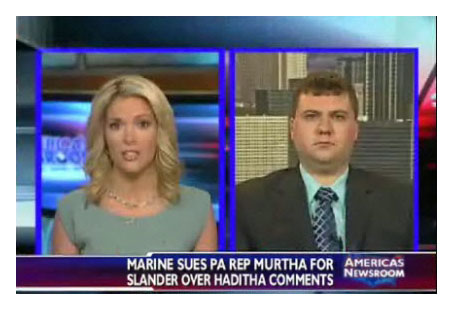 , Fox News, October 1, 2008.
Former Marine Sues Politician Over Remarks About Haditha, Wall Street Journal Law Blog, September 26, 2008.
U.S. Marine sues Rep. Murtha for slander (pdf) UPI, September 26, 2008.
In the Crosshairs: The Lummox Murtha (pdf), BlackFive, September 26, 2008.
Haditha Marine sues Murtha (pdf), Washington Post, September 26, 2008.
On the Docket, (pdf), Fox News, September 26, 2008.
Former Marine Justin Sharratt sues Rep. John Murtha over Haditha killings, Tony Perry, Los Angeles Times blog, September 25, 2008.
Ex-Marine sues Rep. Murtha over Haditha comments, Associated Press, September 25, 2008.
You read it here first! Murtha Faces Triple-Whammy: Sharratt, Chessani, Wuterich plaintiffs. Nathaniel R. Helms, Defend Our Marines, September 25, 2008.
You read it here first! Sharratt Sues Murtha David Allender and Nathaniel R. Helms,Defend Our Marines, September 24, 2008.
LtCol Chessani
Haditha Cover-Up: Murtha Deposition Nixed, Philip V. Brennan, Newsmax, March 5, 2008.
Judge denies request to interview congressman in Haditha case, Associated Press, March 5, 2008.
Read the press release from LtCol Chessani’s attorneys here
The Murtha File

“…they killed innocent civilians in cold blood.”
Representative John Murtha (D-PA), 17 May 2006
“the accused must be presumed to be innocent until his guilt is established by legal and competent evidence beyond reasonable doubt.” — Uniform Code of Military Justice, USC Title 10,
Chapter 47, Subchapter VII, Article 51(c)(1)
May 17-30, 2006: Murtha’s Own Words About Haditha
News
Slander isn’t pretty–or is it? Murtha’s mouthpiece named “most beautiful” guy, Nathaniel R. Helms, Defend Our Marines, Augusts 12, 2008.
Haditha Marine Father Slams Murtha Darryl Sharratt, July 28, 2008
Haditha Cover-Up: Murtha Deposition Nixed, Philip V. Brennan, Newsmax, March 5, 2008.
Judge denies request to interview congressman in Haditha case, Associated Press, March 5, 2008.
Read the press release from LtCol Chessani’s attorneys here
Will John Murtha Apologize for Comments?, Hannity & Colmes, Fox News, September 20, 2007.
Confronting Murtha. Congressman Murtha confronted on video about Haditha (from our pals at Hot Air). Stills are available. September 19, 2007.
Reporter asks Murtha: “Will you apologize to the accused?” September 18, 2007.
Reporter asks Murtha: “At some point, will you apologize to these men?”, September 17, 2007.
Interview with Mark Zaid, attorney for SSgt Frank Wuterich, August 3, 2006.
MSNB’s Hardball (with Mike Barnicle filling in for Chris Matthews)
BARNICLE: Mark Zaid filed the lawsuit for his client, Staff Sergeant Frank Wuterich. Mark, you just heard the Congressman. Is that why you’re suing him, because of what he said then?
MARK ZAID, ATTORNEY FOR FRANK WUTERICH: Well not entirely. There are some defenses that Congressman Murtha could hide behind, and part of it is whether he had met the speech and debate clause. In giving a speech or a press conference over on the Hill could possibly fall within that, but he did more than that. He took those comments and he went out on the road.
He went to numerous media outlets, including this, I believe, this one and your competitors, and said those types of statements, statements like, the Marines killed them in cold blood, that they balked under the pressure, that they were untrained, that they were not under fire. All of those statements are false.
BARNICLE: So you know what Congressman Murtha has said in response to the lawsuit, that I don’t blame the Staff Sergeant for lashing out when I spoke up about Haditha, my intention was to draw attention to the horrendous pressure put on our troops in Iraq and to the cover-up of the incident. So I would assume, never mind the lawsuit, well first of all, what do you hope to get from the lawsuit against Congressman Murtha, before we get into the anticipated trial of your client.
ZAID: Ideally an apology from Congressman Murtha. In fact, we would drop the lawsuit tomorrow if Congressman Murtha admitted or indicated an apology to these Marines, that he had over-reacted and he had prematurely concluded guilt, which is what the problem is. His statement really says it al.
For one thing, this is not a political lawsuit. We have no political motives. We don’t care about whether troops should be in Iraq or not in Iraq. Congressman Murtha raises many legitimate questions in some circles about what the situation is over there, but what he did was irresponsible, especially conduct unbecoming a marine officer, which he was in Vietnam, to go in public, prematurely, months before the investigation is finished, and issue this statement and commentary that in fact he has prejudged these individuals, and tainted not only the jury pool, but ceded the public thought, that in fact these are cold blooded killers, when what they were doing was defending themselves if a very tragic situation where unfortunately collateral victims were killed.
BARNICLE: Have you asked the Congressman for an apology?
ZAID: Not yet. But one of the things we’re actually going to do is we’re going to make that offer to him. If he apologizes for the comments, this is not a case about money, he apologizes for those comments, we’ll very gladly withdraw the lawsuit and then let the investigation, the official investigation, let those chips fall where they may.
BARNICLE: What does the Defense Department, what does Marine Corps and Navy intelligence, investigative services tell you about the investigation? When will it be completed, do you know?
ZAID: Yes. They tell us absolutely nothing actually. Every piece of information we’ve had about the official investigation has come from the media, or anonymous, cowardly leaks from the Defense Department. They shouldn’t be talking to us until in fact there may be charges, if ever, proffered against. That’s what raises the issue. Why were DOD officials talking to Congressman Murtha, who has no reason to know about a premature or a pending criminal investigation into the conduct of these Marines.
BARNICLE: Who do you think told them?
ZAID: Well, he had said, in fact, that it was the commandant of the Marines, which raises additional issues of command influence. If in fact Congressman Murtha is telling the truth and I have a great doubt believing that the commandant of the Marines, three months before an investigation was complete, would meet with a Congressman and say you know what, my boys committed cold blooded murder and are war criminals on the same level as the My Lai Massacre from back in Vietnam, but if in fact he said that, those people or those judges who will be serving in the Marines who are overseeing these cases …
BARNICLE: The trial board.
ZAID: If they’re looking at the Marine commandant saying that these fellows are guilty, well that’s a problem with commander influence.
BARNICLE: Your client, where is he right now? Out at Camp Pendleton?
He’s not in the brig is he?
ZAID: Not in the brig. In fact, he was promoted in January of this year, once he came back, actually before he even came back from Iraq and he goes to work every day and does his performance and his duties just as he has for the last eight years.
BARNICLE: So, never mind, you don’t know what possible charges might be filed against your client. You don’t know if charges will be filed.
ZAID: That’s right. All we’ve known so far is that NCIS has been reported to have completed its investigation, but will still do interviews and even if that is true, the anonymous military officials who are saying charges will be brought, they have no idea, because the NCIS does not decide whether charges will be brought. They send the documents, their investigative reports to the prosecutors and then the prosecutors have to talk to the charging officials to decide. This is weeks away, so whoever these sources are is doing nothing but feeding some sort of frenzy for some private agenda.
ZAID: … prosecutors and then the prosecutors have to talk to the charging officials to decide. This is weeks away, so whoever these sources are, is doing nothing but feeding some sort of frenzy for some private agenda.
BARNICLE: All right. So if charges are filed, I would assume they would be the most serious that you could accrue against someone, they would be murder.
ZAID: I would assume so.
BARNICLE: Let’s assume so. You’ve had extensive discussions with your client, Sergeant Wuterich, so would the defense, the potential defense of the Sergeant Wuterich against such a charge, would it be for the American public a clear picture, a clear insight in to the pressures that these troopers, Marines and army soldiers, are under each and every day in Iraq?
ZAID: Well, I can’t speak for all the Marines who potentially could be charged, because each of them may have been under different circumstances. Staff Sergeant Wuterich, this was actually his first tour in Vietnam, sorry, in Iraq. He had just gotten there. He had been in the military for a number of years, but he wasnt under any type of pressure that I’m aware of that might lead to it.
I mean, there’s a number of obvious defenses. The best one being self defense. They were under fire. There were bullets going by them. There had been a bomb, an IED. that had kill one of their individuals, one of their colleagues. They went into a house, and there were Iraqis with automatic weapons pointed at them, who they killed. It’s expected that in split second decisions, they have to decide, is this a threat or not and sometimes as I said, civilians unfortunately are killed. It’s happened in every war we’ve ever been in, in the history of mankind.
BARNICLE: Come back and talk to us about it when, if charges are filed?
ZAID: Or if Congressman Murtha apologizes.
BARNICLE: Mark Zaid, thanks very much.